
How to Manage a Cabling Subcontractor on Your Jobsite
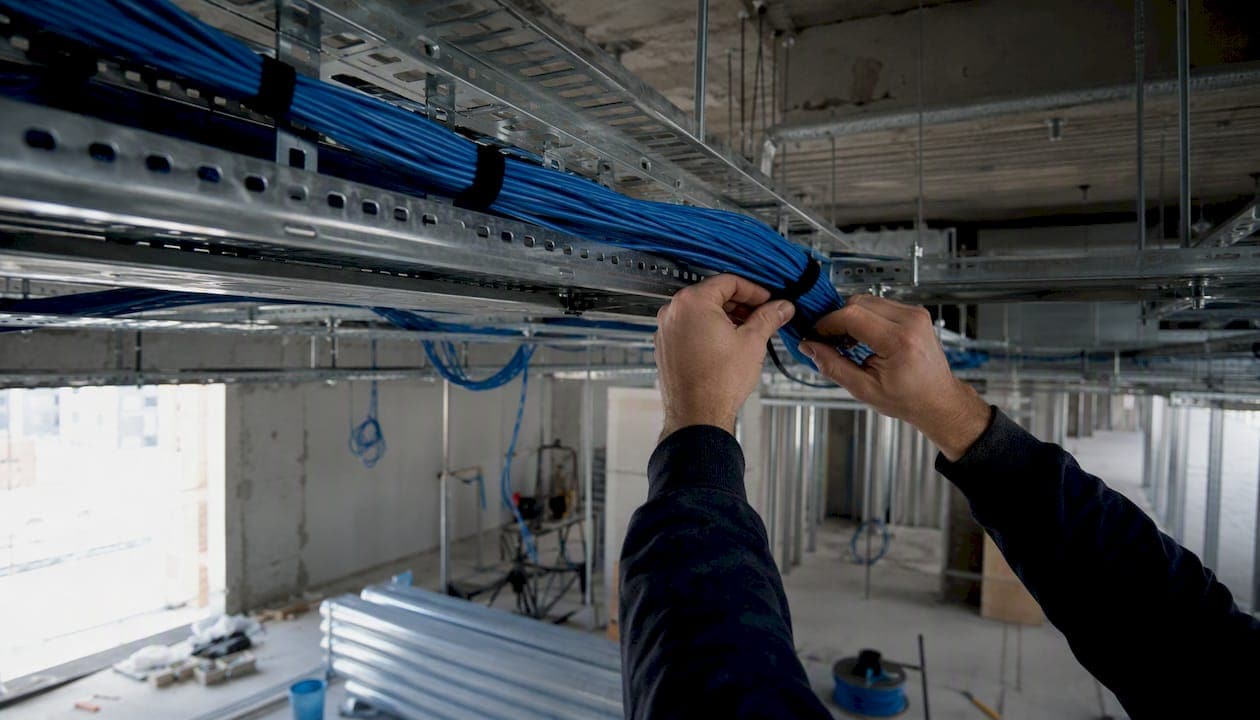
To manage a cabling subcontractor on a jobsite effectively, lock four things before the crew mobilizes: a written scope with pathway ownership defined, confirmed cable routes and distribution points, a submittal gate tied to the purchase order and a written requirement for per-drop TIA-certified test reports at closeout. Assign a single point of contact on both sides, reference OSHA and NEC (NFPA 70) compliance in the subcontract, and load all submittals and RFIs into a centralized platform like Procore from day one.
Day-one mobilization checklist for the PM:
-
Issue the mobilization PO only after the submittal package (shop drawings, product data, test instrument model) is approved
-
Confirm cable routes, cable-tray locations, and distribution points on the coordinated drawings before rough-in begins
-
Require the cabling sub to name a dedicated project manager as the single point of contact
-
Record the TIA performance level (Category 6 or 6A) and the certification tool baseline (Fluke DSX or equivalent) in the subcontract
-
Load all RFIs, submittals, and daily reports into Procore or your chosen platform so nothing lives in email
-
Set a written acceptance gate: no AV or IT equipment install until per-drop certification reports are received and reconciled
Cables and Chips has run this playbook on commercial office projects in New York City for more than 40 years. The sections below break each step into a practical checklist you can apply from pre-bid through final turnover.
Key Takeaways
Effective cabling subcontractor management starts before mobilization: the PM who locks scope, routing, and acceptance criteria at award controls the project through closeout.
| Point | Details |
|---|---|
| Lock scope before award | Define pathway ownership, termination counts, testing standard, and labeling format in the subcontract before issuing the PO. |
| Require a submittal gate | No mobilization until shop drawings, product data, and the tester calibration certificate are approved in writing. |
| Enforce a certification gate | No AV or IT equipment install until per-drop TIA test reports are received, reconciled, and accepted by zone. |
| Budget pathway costs separately | Pathway costs (conduit, tray, backboxes) often represent 25% of the LV install; require separate bid line items to evaluate scope clearly. |
| Cables and Chips | Provides structured cabling, certified testing, and complete as-built documentation for commercial projects in New York City. |
How do you coordinate cabling subcontractors before mobilization?
Preconstruction coordination is where most cabling delays are actually born. By the time a crew is pulling cable above the ceiling, it is too late to resolve a conflict with HVAC ductwork or discover that nobody owns the conduit to a security camera backbox.
Lock the routing plan before rough-in. Require the cabling sub to submit a consolidated conduit and cable-tray routing plan that overlays LV pathways with electrical, HVAC, and fire-protection runs. Then schedule one above-ceiling coordination meeting with all four disciplines before rough-in begins. Above-ceiling conflicts are exponentially more expensive to resolve in the field than on a drawing, and a single two-hour meeting routinely eliminates weeks of rework. For practical guidance on cable tray selection and routing in commercial spaces, the coordination principles apply directly to this pre-mobilization step.
Deliverables to request before the subcontract is awarded:
- Room-level outlet schedule (data, voice, WAP, AV, security) with counts per room
- TR/MDF room dimensions and rack elevation drawings
- WAP locations confirmed by the wireless design (late WAP changes are a leading cause of rework; see the WAP cabling planning guide for scope implications)
- Owner-furnished equipment list with rough-in dimensions
- Proposed cable-tray sizes, fill calculations, and support spacing
Divide the floor plate into cable zones. Assign each zone a distribution point (IDF or consolidation point), and map which rooms fall under each zone. Zones reduce access conflicts between trades, simplify testing sequences, and make it far easier to track progress by area rather than by individual drop count.
The most common low-voltage scope gap is pathway ownership: who supplies conduit, backboxes, and cable tray for owner-direct systems. Resolve this in the bid documents, not after award.
Pro Tip: Build a “conduit ownership matrix” — a simple spreadsheet mapping each pathway segment by room number, discipline, and responsible party. When a backbox goes missing or a conduit run is disputed, this single document resolves the argument in minutes instead of days.
Per OSHA and NEMA guidance, cable trays are structural systems with fill, support, and grounding requirements. Overfilling trays and leaving abandoned cable in place create mechanical and electrical hazards. Confirm tray sizing accounts for future fill before the first cable is pulled.
What should a cabling subcontract scope of work include?
A vague scope produces incomparable bids and a change-order-heavy project. The subcontract must define every deliverable the PM will use to accept the work, not just the cable type and count.
Scope items to require in every cabling subcontract:
- Pathway ownership: explicitly state who supplies cable tray, conduit, backboxes, and sleeves
- Termination counts by type (RJ45, LC fiber, punch-down blocks) and location
- Testing standard: TIA 568 Category 6 or 6A, with the certification instrument model recorded (Fluke DSX or equivalent)
- Labeling format: cable ID convention, both-end labeling, patch-panel schedule format
- Submittal gate: no mobilization until shop drawings and product data are approved
- Dedicated project manager contact named in the contract
- Punchlist process: written defect log, re-test requirement, and re-test timeline
- Warranty conditions: duration, scope of coverage, and manufacturer application-assurance warranty when the owner requires a long-term system warranty
Contract clause prompts that prevent disputes:
- Submittal gate clause: “Subcontractor shall not mobilize for rough-in until the GC has issued written approval of the submittal package.”
- PO hold clause: “Final invoice will not be processed until the GC receives a complete handover package including per-drop test reports, patch-panel schedule, and photo-labeled termination evidence.”
- Invoice timing clause: “Progress billing is tied to zone-level completion milestones as defined in the project schedule.”
Well-scoped written briefings and formal handover gates prevent cost leakage and stop informal scope additions from accumulating. A PO that references the scope document by revision number closes the most common loophole.
Pro Tip: Require a single signed handover document — combining the per-drop test reports, the patch-panel schedule, and photo-labeled termination evidence — as the gate that releases the next trade. One document, one signature, no ambiguity.
How does cabling work fit into the master schedule?
Cabling is rarely on the critical path at the start of a project, but it almost always ends up there. The reason is sequencing: AV and IT equipment cannot install until cabling is certified, and cabling cannot terminate until rough-in is complete and walls are closed.
Milestones to protect in the CPM schedule:
- Rough-in complete (conduit, backboxes, cable tray in place, above-ceiling access open)
- Cable pull complete by zone
- Termination and patching complete by zone
- Certification and test reports issued by zone
- AV/IT equipment install authorized (gate: certification reports received)
- Final punchlist and closeout documentation
Pull planning and lookahead rhythm. Run a weekly three-week lookahead with the cabling foreman, electrical sub, and HVAC sub in the same room. The gate to mobilize the cabling crew into a zone is written confirmation that rough-in is complete and above-ceiling access is clear. Without that written gate, crews waste mobilization time and generate access conflicts.
Material lead times affect schedule float more than most PMs expect. Patch panels, fiber breakout cassettes, and Cat6A reels on large projects can carry lead times of several weeks. Tester calibration certificates for the Fluke DSX must also be current at the time of certification; an expired calibration invalidates the test reports. Build both into the procurement schedule, not as afterthoughts.
What OSHA and NEC rules apply to cabling work on a jobsite?
Low-voltage work is not exempt from OSHA enforcement. Cable trays, exposed conductors, and energized equipment in telecom rooms all carry specific compliance requirements that the PM must enforce.
Compliance summary for the PM:
- OSHA 29 CFR 1910.303(g)(2)(i) requires live parts operating at 50 volts or more to be guarded by approved enclosures, permanent partitions, elevation of at least 8 feet, or location in restricted-access spaces. Insulated cables alone do not satisfy this guarding requirement.
- 29 CFR 1910.305 lists permitted wiring methods for cable tray systems and requires that conductors for general wiring be insulated unless a specific exception applies.
- NEC (NFPA 70) defines wiring methods and safety expectations that OSHA accepts as meeting compliance in most cable-tray and wiring installations.
- Cable tray fill, support spacing, and grounding continuity are structural requirements, not suggestions. Overloaded trays risk mechanical failure and arc-flash events.
Site-level safety checklist for PMs:
- Confirm all live parts above 50V are guarded or elevated before cabling crews work in proximity
- Verify cable tray fill does not exceed the tray’s rated capacity (NEC Section 392)
- Require LOTO (lockout/tagout) procedures for any energized work in telecom rooms or near live panels
- Confirm PPE requirements (safety glasses, insulated gloves for energized proximity work) are communicated in the site-specific safety plan
- Check that cable ties and supports are rated for the environment (plenum vs. non-plenum, wet locations)
- Require the cabling sub to remove abandoned cable from trays before new cable is pulled
Pro Tip: Add NEC and OSHA code references directly to your submittal review checklist. When a superintendent can cite “NEC 392.22 fill limit exceeded” on a rejection notice, the sub corrects it immediately rather than debating whether it matters.
What documentation must you require before accepting cabling work?
Accepting cabling work without certified test reports is the single most common cause of AV installation delays. The PM’s rule is simple: no AV or IT equipment install until per-drop certification reports are in hand and reconciled against the outlet schedule.
Test report requirements:
- Per-drop certification to the TIA performance level specified in the subcontract (Cat6 or Cat6A)
- Instrument model and calibration date recorded on every report (Fluke DSX or equivalent)
- Pass/fail result per port, with failed ports flagged for rework
- Consolidated test report file as a closeout deliverable, organized by zone and patch-panel port number
Labeling and as-built deliverables:
- Cable ID convention applied at both ends (patch panel and outlet)
- Photo evidence of both-end labels, timestamped and location-tagged
- Patch-panel schedule matching test report port numbers
- Rack elevations showing final port assignments
- Cable routing plans updated to reflect as-built conditions
For a complete closeout checklist, the structured cabling as-built documentation guide covers labeling conventions, rack documentation, and the deliverable format that supports long-term serviceability.
| Acceptance deliverable | Minimum standard | Who verifies |
|---|---|---|
| Per-drop test reports | TIA Cat6 or Cat6A pass, instrument model recorded | PM or LV inspector |
| Patch-panel schedule | Port-for-port match to test report IDs | PM |
| Photo-labeled terminations | Both ends, timestamped, location-tagged | PM or superintendent |
| As-built cable routing plan | Updated to reflect installed conditions | Cabling sub, PM review |
| Rack elevations | Final port assignments documented | Cabling sub |
Centralizing these documents on a single platform reduces missed requirements and prevents the expensive out-of-scope rework that happens when AV installers arrive to incomplete or undocumented cabling.
A three-document handover — per-drop test reports, matching patch-panel schedule, and photo-labeled termination evidence — is the simplest gate to stop the next trade from mobilizing to incomplete work.
How should you run daily supervision and communication on a cabling install?
The PM who waits for problems to surface loses schedule. A daily huddle and a weekly coordination meeting, both documented, are the two controls that keep cabling work visible and disputes attributable.
Daily huddle template (10 minutes, every morning):
- Locations worked yesterday and zones completed
- Locations planned today and crew size
- Blockers: access issues, missing materials, open RFIs
- Materials needed within 48 hours
- Any safety observations or near-misses
Weekly coordination meeting agenda:
- Three-week lookahead review with zone-level status
- Open RFI log review (age, owner, target close date)
- Submittal status update
- Material delivery confirmations
- Schedule impact assessment for any open items
Communication protocol to enforce from day one:
- Single-point PM contact on both sides: one name, one phone number, one email
- All RFIs submitted in writing through the project management platform (no verbal RFIs)
- Photo log updated daily: minimum one photo per zone worked, timestamped and location-tagged
- Change order requests submitted within 48 hours of the triggering event, with written backup
Project management platforms that centralize RFIs, drawings, and submittals reduce missed requirements and costly rework. Verbal agreements are the single most common source of downstream disputes on cabling projects; a documented daily huddle note eliminates that exposure.
Pro Tip: Require the cabling foreman to submit a one-page daily report through Procore or Fieldwire at the end of each shift. It takes five minutes to write and creates an auditable record that resolves most change-order disputes before they escalate.
Which software tools help you manage a cabling subcontractor?
The right platform reduces admin load and creates the documentation trail that protects the PM at closeout. The core requirement is centralization: drawings, RFIs, submittals, test reports, and daily reports in one place.
Feature checklist for evaluating PM platforms:
- Drawing markup and version control (so the cabling sub always works from the current set)
- Mobile photo upload with geotags and timestamps
- Test-report attachment and storage by zone or port number
- PO and submittal gating (system blocks mobilization until approvals are recorded)
- RFI tracking with age and owner visibility
- Push notifications for overdue submittals or open RFIs
| Platform category | Best for | Key strengths | Limitations |
|---|---|---|---|
| Enterprise PM platforms (e.g., Procore) | Large commercial projects with multiple subs | Full document control, RFI/submittal gating, subcontractor portals, reporting | Higher cost; setup time required |
| Entry-level field apps (e.g., Fieldwire) | Mid-size projects, field-first teams | Fast mobile adoption, drawing markup, task assignment, photo logs | Lighter document control; fewer integrations |
| Shared drawing platforms | Drawing coordination only | Simple, low cost, easy sub access | No RFI/submittal workflow; no test-report storage |
Procore’s subcontractor management guidance consistently points to a single platform for communications and documents as the control that avoids the verbal-agreement trap. Fieldwire is a practical alternative for field-first teams on mid-size projects where full enterprise PM overhead is not warranted.
Pro Tip: Require the cabling sub to upload test reports directly into the project platform as each zone is certified, not as a batch at closeout. Zone-by-zone uploads let you catch failed ports while the crew is still on site and the fix costs an hour, not a return mobilization.
What are the most common cabling install problems and how do you fix them?
Most cabling problems on commercial jobsites are predictable. The PM who knows the failure modes in advance can set the controls before the problem occurs rather than reacting after the fact.
Scope gap: conduit or backbox not provided
First-line fix: reference the conduit ownership matrix and the subcontract scope. If the gap is genuine, issue a written change order before the sub proceeds. Stop work on the affected zone until pathway ownership is resolved in writing.

Incorrect or missing labeling
First-line fix: reject the zone at the daily inspection. Require the sub to re-label both ends and resubmit photo evidence before the zone is accepted. Do not allow the next trade to access an unlabeled zone.
Failed certification test
First-line fix: require a written rework plan identifying the cause (bad termination, damaged cable, wrong category component). Re-test after rework. Hold the zone’s invoice milestone until the re-test passes. Per OSHA and NEMA guidance, failed cables in trays that are then abandoned in place create additional hazards; require physical removal, not just documentation of the failure.

Cable tray overfill
First-line fix: stop cable pulls in the affected tray segment. Require the sub to submit a revised fill calculation and a corrective plan (upsizing the tray, adding a parallel tray, or rerouting). Do not allow additional cable in the tray until the plan is approved.
Above-ceiling space conflict
First-line fix: issue an RFI immediately and schedule a field coordination meeting with the conflicting trade within 24 hours. Document the agreed resolution in writing before either trade resumes work in the affected area. For guidance on open-ceiling routing and conflict avoidance, the principles apply directly to active conflict resolution.
Escalation sequence for any of the above:
RFI issued in writing → documented rework plan submitted by sub → rework completed and re-inspected → re-test if applicable → invoice milestone released only after written acceptance.
How long does cabling work take, and what should you budget?
Budget cabling scope in four phases: mobilization and rough-in, cable pull, termination and certification, and punchlist/closeout. Treating them as one lump sum makes it impossible to track progress or identify where cost is accumulating.
Typical productivity ranges for commercial horizontal cabling:
- Horizontal drops (Cat6/Cat6A): productivity varies by ceiling type and access conditions; open ceilings with clear tray access run faster than grid ceilings with congested pathways
- Backbone fiber pulls: schedule time for both the pull and the splice or termination separately; fusion splicing and LC termination are skilled tasks with their own productivity rates
- Termination and certification: budget roughly the same duration as the cable pull for a well-run project; rushed termination is the leading cause of failed test reports
Budgeting guidelines:
- Separate pathway costs (cable tray, conduit, backboxes, sleeves) as a distinct line item. Pathway costs often represent a significant portion of the total low-voltage install cost when cable tray and conduit are included. Requiring clear bid line items for pathway vs. cable vs. labor prevents scope confusion and makes change orders easier to evaluate.
- Allow 10–25% contingency for coordination-driven rework, depending on project complexity. Simple tenant fit-outs with clear drawings sit at the low end; multi-tenant base-building projects with owner-furnished equipment changes sit at the high end.
- Hidden cost drivers to protect against: late WAP location changes (each move can require a full re-pull), owner-furnished equipment changes that shift rack locations, and abandoned cable removal that was not scoped.
Pro Tip: Require the cabling sub to break out pathway cost as a separate bid line item. When a GC can see that conduit and backboxes are 30% of the bid, it becomes immediately clear whether the electrical sub or the LV sub owns that scope, and the conversation happens before award rather than during construction.
What does final commissioning and turnover look like for cabling work?
Final acceptance is not a handshake. It is a documented event with a specific set of deliverables that must be received, reviewed, and signed before the cabling sub’s final invoice is released.
One-sentence rule: Receive all per-cable certification reports, as-built drawings, the patch-panel schedule, and photo-labeled termination evidence before signing final acceptance.
Commissioning steps in sequence:
- Witness the test plan execution for a sample of drops (or all drops on smaller projects) to confirm the instrument, the operator, and the test parameters match the subcontract requirement
- Compile the closeout binder: test reports organized by zone and port, patch-panel schedule, as-built routing plans, rack elevations, and photo log
- Reconcile open punchlist items: every failed test, missing label, and incomplete termination must be resolved and re-documented before final sign-off
- Record warranty start dates in the project management system, tied to the signed acceptance date
- Confirm manufacturer application-assurance warranty conditions are met if the owner requires a long-term system warranty (this requires specific installation practices and documentation submitted to the manufacturer)
Security and AV trades depend directly on a clean cabling handover. The dependency between cabling subs and security installers is a useful reference for understanding why the commissioning gate matters beyond just the data network.
How Cables and Chips ran a commercial office rewiring with minimal rework
A mid-size commercial office rewiring in Lower Manhattan required replacing legacy Category 5e infrastructure with Cat6A across multiple floors while the building remained partially occupied. The constraints were tight: above-ceiling access was shared with active HVAC and electrical work, WAP locations were confirmed late, and the AV integrator had a fixed mobilization date.
Controls applied from the start:
- Consolidated conduit routing plan submitted and approved before rough-in, with a conduit ownership matrix covering all LV pathways
- Submittal gate enforced: no cable pull began until shop drawings, product data, and the Fluke DSX calibration certificate were approved
- Daily huddles with documented attendance and a zone-level lookahead updated every morning
- Single PM contact on both sides, with all RFIs logged in the project platform
- Per-drop certification gate: AV mobilization was contractually blocked until zone-by-zone test reports were uploaded and reviewed
Outcomes:
- Punchlist items at final walkthrough were limited to minor labeling corrections, all resolved within one return visit
- AV integrator mobilized on the scheduled date with complete, certified cabling in every zone
- Per-drop certification reports were delivered as a consolidated closeout file, organized by floor and patch-panel port
- As-built drawings and photo-labeled termination evidence were submitted with the final invoice, eliminating any dispute over scope completion
The project demonstrated that the controls described in this playbook, applied consistently from pre-bid through closeout, produce a measurably cleaner handover and protect the schedule for every trade that follows.
What usually trips up cabling projects — and what to do about it
The single biggest cause of cabling delays is unclear pathway ownership at rough-in. Not bad cable. Not failed tests. The question of who supplies the conduit to a security camera backbox, answered informally or not at all, is what stops a crew cold on day three.
The cultural fix is simpler than most PMs expect: one coordination meeting before rough-in, one conduit ownership matrix, and one named contact on each side. Those three controls eliminate the majority of the disputes that generate change orders and schedule slippage on cabling projects. The technical work, pulling Cat6A and terminating it correctly, is well within the capability of any qualified sub. The coordination work is where projects succeed or fail.
The shortcut to avoid is the verbal agreement. A superintendent who resolves a scope question with a phone call and no follow-up email has created a liability. The same answer in writing, logged in Procore or Fieldwire, is a project record. The discipline of writing it down is not bureaucracy; it is the difference between a clean closeout and a disputed final invoice.
Cables and Chips brings the full playbook to your next NYC project
Cables and Chips delivers structured CAT6 and CAT6A cabling installation for commercial offices and secure facilities throughout New York City, with the documentation controls this playbook describes built into every project. That means a consolidated routing plan before rough-in, a submittal gate before mobilization, per-drop Fluke DSX certification reports at closeout, and complete as-built documentation delivered with the final invoice.
With more than 40 years of experience running low-voltage scopes on active commercial jobsites, Cables and Chips provides a single point of contact, daily progress reporting, and a signed three-document handover that releases the AV and IT trades on schedule. Fiber optic backbone, WAP cabling, CCTV and access control, VoIP infrastructure, and network closet organization are all available under one contract.
To request a scoped mobilization package or schedule a site review, contact Cables and Chips at Cables.
Sources
The following sources are the primary references for the compliance, testing, and project controls covered in this playbook:
- Hiring subcontractors: How to find, evaluate and manage the right team
- OSHA standard interpretation regarding guarded live parts and cable trays
- Cable Tray Systems safety information bulletin
- 29 CFR 1910.305 — Wiring Methods, Components, and Equipment for General Use
- Low Voltage Scope of Work Template (2026) | Provision
- Sub-Contractor Management for AV Integrators – Zigaflow
FAQ
How do you manage subcontractors effectively on a jobsite?
Set clear written expectations before mobilization, enforce a submittal gate tied to the PO, and run documented daily huddles. Centralizing all RFIs, submittals, and reports on one platform eliminates the verbal-agreement trap that causes most downstream disputes.
What are the hazards of poor cable management on a construction site?
Overfilled cable trays risk mechanical failure and arc-flash events, and abandoned cable adds structural load that can exceed tray ratings. OSHA and NEMA guidance requires trays to be properly filled, supported, and grounded, with abandoned cable removed.
What app is best for managing cabling subcontractors on a jobsite?
Procore is the leading enterprise option for large commercial projects, offering full document control, RFI and submittal gating, and subcontractor portals. Fieldwire is a practical field-first alternative for mid-size projects where mobile adoption and drawing markup are the primary needs.
How do you handle a cabling subcontractor who fails certification tests?
Require a written rework plan identifying the cause before any rework begins, then re-test after the fix is complete. Hold the zone’s invoice milestone until the re-test passes and the updated test report is uploaded to the project platform.
When should you allow AV or IT equipment installation to begin?
Only after per-drop TIA certification reports for every zone are received, reconciled against the outlet schedule, and accepted in writing. A three-document handover — test reports, patch-panel schedule, and photo-labeled terminations — is the minimum gate before the next trade mobilizes.